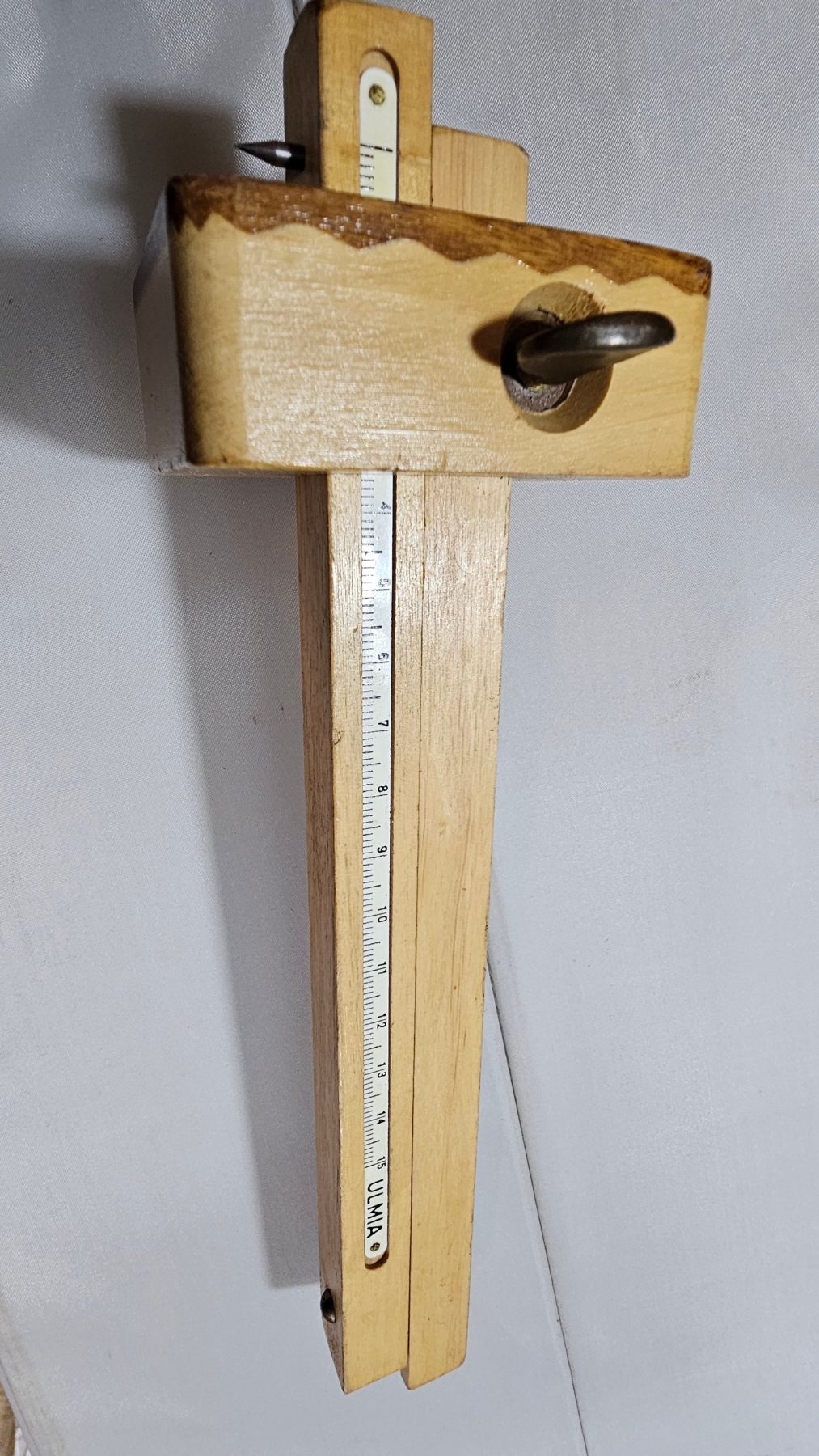
ULMIA double marking gauge (Doppelstreichmaß)
ULMIA · 1960–1999
Item passport
- Maker
- ULMIA
- Country
- Germany
- Dating
- Presumably the 1960s–1990s (second half of the 20th century), judging by construction and styling; the dating is provisional.
- Condition
- A cleaned and preserved marking tool. The sharpness of the steel pins has been restored. The original construction, the legible scale and the age texture of the wood are…
Dimensions
- scale150 mm
Wooden marking gauge with two marking bars for scribing lines parallel to a reference edge of the workpiece. The two adjustable bars allow two dimensions to be kept and the boundaries of joints to be marked out. A sliding fence (stock) locks the bars with a…
Read the storyHistory
Wooden marking gauge with two marking bars for scribing lines parallel to a reference edge of the workpiece. The two adjustable bars allow two dimensions to be kept and the boundaries of joints to be marked out. A sliding fence (stock) locks the bars with a screw clamp; the bars carry sharp steel marking pins and recessed scales up to 15 cm. Marking is done with the fence held firmly against the edge of the wood.
Dating. Presumably the 1960s–1990s (second half of the 20th century), judging by construction and styling; the dating is provisional.
Parts and their origin
| Body | ULMIA, Germany ULMIA |
|---|---|
| Other |
|
| Other |
|
Marks and stamps
-
documented
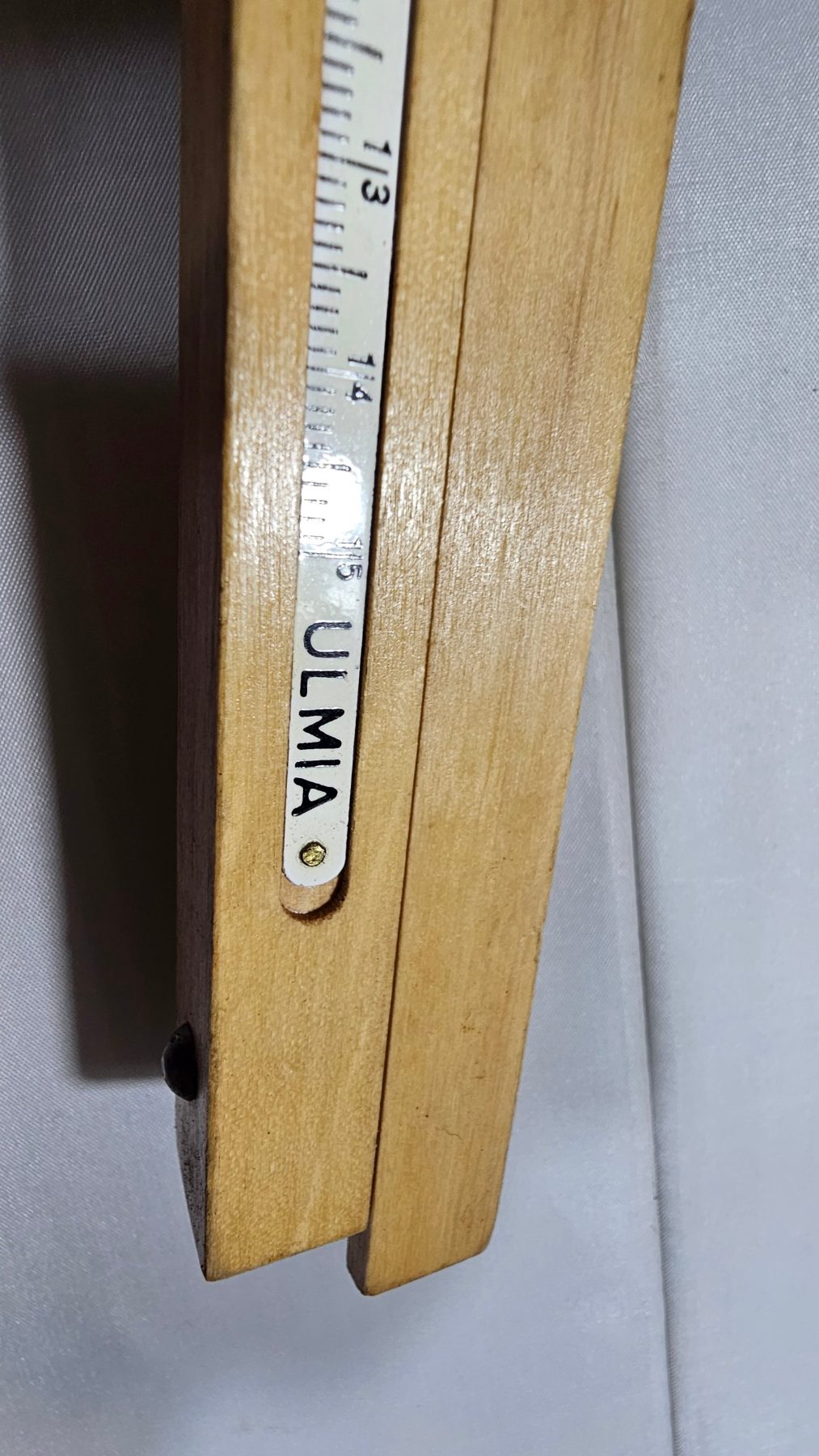
ULMIA lettering on the pale inset scale; the divisions and numerals are preserved.
Restoration
The wooden parts were cleaned with 100% alcohol and given a thin layer of natural wax; the markings, scales and traces of use were kept. The thumbscrews were gently cleaned with a soft Scotch-Brite and ISO 68 oil. The steel tips of the pins were sharpened on 400-grit abrasive paper and coated with ISO 68 oil to protect them from corrosion.
Work history
- 2026: the wooden parts were cleaned with 100% alcohol; the thumbscrews were gently cleaned with a soft Scotch-Brite and ISO 68 oil.
- 2026: the steel tips of the marking pins were sharpened on 400-grit abrasive paper.
- 2026: a thin layer of natural wax was applied to the wood and the pins were coated with ISO 68 oil. Restoration is complete.
Sources
Research status
The construction corresponds to the ULMIA 0029 catalogue family; the number is not confirmed. For that family the catalogue lists hornbeam (Weißbuche), a Pockholz fence facing and a brass screw; the wood species and alloys of this example are not confirmed. The bronze thumbscrews are the owner's identification; the alloy has not been analysed.
Purchase and price
Place of purchase and price are visible after signing in. Sign in